BLOG POST | 28 Jul 2026
The Refugee Convention at 75: time to address climate-conflict displacement
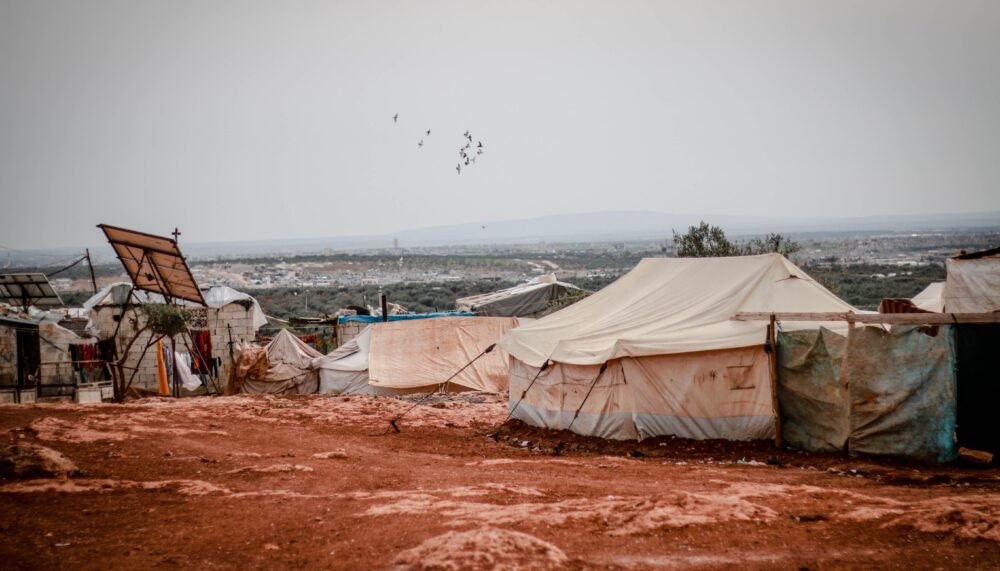
Eighty-three million internally displaced persons fall outside the world's main binding protection treaty. Climate change is adding millions more.
By Laís Clemente Pereira, Alexandra Steinkraus, Nike Löble
This article was originally published as an opinion piece in Climate Diplomacy on 28 July 2026.
The co-authors, Alexandra Steinkraus and Laís Clemente Pereira, work in the Climate Diplomacy and Security team at adelphi.
Seventy-five years ago, the world's governments gathered at the United Nations in Geneva to ensure that refugees would not be left without protection. On 28 July, the world marks the anniversary of that effort: the 1951 Refugee Convention, a landmark treaty that has shaped international protection for those who are forced to flee their countries of origin. Yet one of today's fastest-growing displacement realities falls entirely outside of the Convention’s scope. Internally displaced persons (IDPs) — who move due to conflict, violence, or climate stress without crossing a border — have no equivalent binding global treaty. The, UN Guiding Principles on Internal Displacement provide a widely referenced framework, and the African Union’s Kampala Convention makes them legally binding across much of the African continent. However, no comparable instrument applies globally or is backed by the financing or enforcement mechanisms that the scale of the crisis demands.
The global IDP population has more than doubled since 2018. Climate change is contributing to this rising trend. It is already intensifying droughts, floods, fuelling resource competition and primarily resulting in displacement within, rather than across, borders.
The numbers paint a worrying picture. The global IDP population has more than doubled since 2018, reaching a record of 83.4 million across 117 countries and territories in 2024. Among those, Syria and Colombia are the countries with the largest share of IDPs. Climate change is contributing to this rising trend. It is already intensifying droughts, floods, fuelling resource competition and primarily resulting in displacement within, rather than across, borders. The World Bank projects that up to 216 million people could become internal climate migrants by 2050, driven by water scarcity, collapsing crop yields, and rising seas, with severe population shifts possible as early as 2030.
Climate-driven internal displacement is by no means a future trend. Research shows that in Syria, recurring drought combined with over a decade of conflict is shaping displacement. Six million people remain internally displaced as of 2025, concentrated in inadequate housing with limited access to basic services or income. Climate-related hazards fall hardest on precisely those communities. For many, return is not a realistic option: ongoing instability, lack of employment and hundreds of thousands of unexploded weapons render large areas inaccessible, while degrading soil, water, and biodiversity. When people do return, they do so under immediate pressure rather than considered choice. Climate considerations have yet to be integrated into any serious return or recovery planning.
Iraq tells a similar story. Prolonged drought, water scarcity, and declining agricultural productivity are driving internal movement while placing additional pressure on already vulnerable host communities. Currently, over 180,000 individuals remain displaced because of climatic factors. These dynamics strain water systems, livelihoods and infrastructure, intensifying competition over shared resources, and increasing tensions within affected communities, while highlighting broader challenges in service provision and climate adaptation.
Colombia, meanwhile, faces a displacement crisis shaped by both armed violence and environmental threat. Over seven million IDPs as of 2025 are deeply affected by violence and highly vulnerable to sudden climate emergencies like floods.
These contexts illustrate more than a problem. They also point towards a more adequate response to this crisis: a holistic approach that considers climate, conflict and displacement, and puts communities at the centre.
First, climate-related pressures cannot be addressed in isolation from the conflicts and governance challenges that shape how communities experience and address them. In many contexts, weak governance structures, limited institutional capacity and low levels of trust between communities and public authorities make it more difficult to manage climate-related risks. In Iraq, for example, district level dialogue and mediation processes have shown that communities can come together to identify how climate change is fuelling tension and develop joint solutions to address both water shortages and disputes over scarce resources. In terms of policy, Colombia has taken a significant step: a law passed in June 2026 extends the same legal protections and long-term support currently available to persons displaced by conflict to those uprooted by climate and environmental causes, with an explicit focus on prevention and adaptation. The document paves the way for interventions that consider both climate and mobility and shows that national frameworks can be updated to reflect the realities of climate-driven displacement without waiting for international consensus.
What is needed is a shift in how we understand mobility: not only as a humanitarian challenge after displacement occurs, but as part of a broader climate-security challenge.
Second, durable solutions depend on whether they are grounded in the realities of the communities they aim to support. In Syria, decades of civil society suppression have not extinguished community resilience. Local networks have often sustained communities when the state could not. This resilience can now be a foundation for rebuilding trust within Syria and for placing local initiatives at the heart of stabilisation efforts. Experience in Iraq shows that linking community-led initiatives with district, governorate, and national systems not only helps identify climate-conflict responses that work in specific contexts, but also creates pathways to adapt, replicate and scale these successful approaches across other affected areas.
The 75th anniversary of the Refugee Convention is a moment to reflect holistically on the challenges of displacement. Internal displacement driven by climate change is no longer an outlier or a future phenomenon. Existing international policy, protection and financing systems were not designed to deal with it. Climate finance and peacebuilding finance must no longer operate in parallel when the risks they address increasingly overlap. This matters all the more at a moment when international systems are themselves under strain: shrinking budgets, weakening multilateral institutions and declining trust in both global and national governance make fragmentated efforts even harder to justify. What is needed is a shift in how we understand mobility: not only as a humanitarian challenge after displacement occurs, but as part of a broader climate-security challenge. One that requires conflict-sensitive adaptation and mechanisms to address climate-related tensions before they escalate.
Media contact
You can reach the press team at:
+49 (0) 177 7052758
email hidden; JavaScript is required