BLOG POST | 29 Sept 2026
Beyond the climate security conference room
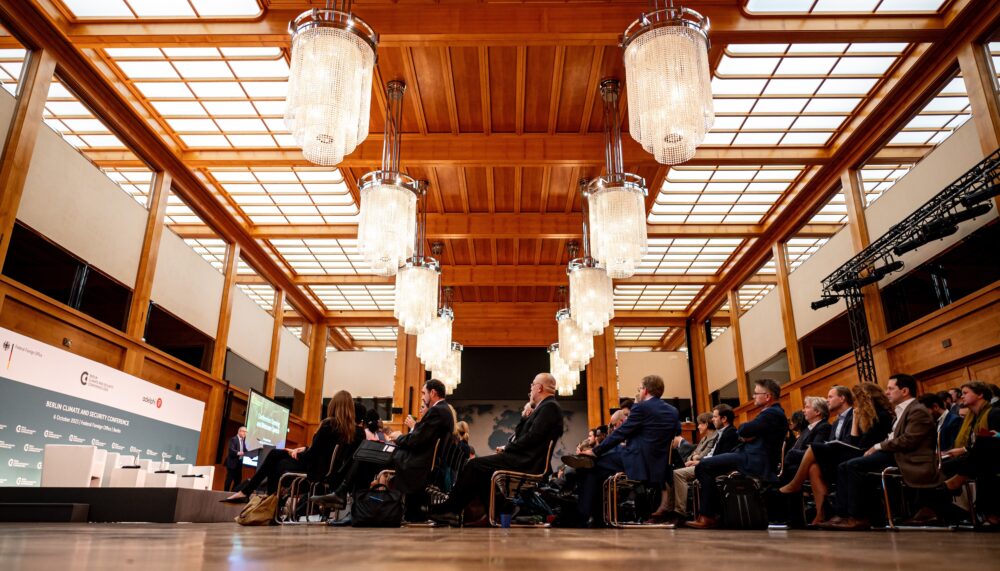
Ahead of the Berlin Climate and Security Conference, read Nazanine Moshiri’s reflections on how we can move climate security from talk to action.
By Nazanine Moshiri
I have been attending the Berlin Climate and Security Conference (BCSC) since 2022. In my professional world, BCSC has become one of those gatherings you feel you should be at once a year.
What surprises me is that the conference still commands so much interest. Climate and peace are hardly easy political sells right now. Europe is preoccupied with deterrence, defence and economic security. Climate language has become more contested, while peacebuilding can sound distinctly soft beside the language of hard security.
And yet government officials, representatives from international organisations, donor agencies, researchers, think tanks, NGOs and civil society still come to Berlin to discuss the relationship between climate change, peace and security. The issue clearly has not gone away, but those of us working in this field should be asking ourselves whether we are changing quickly enough with the world beyond the conference hall.
For years, much of our work involved persuading governments that climate change belonged in security discussions at all. That argument has travelled a long way.
The UK is a good example. In June, it launched its first climate and nature security taskforce, bringing together military, security, academic and climate expertise. Its particular added value is that climate change now sits firmly inside a discussion about national security, economic resilience and preparedness.
The European Union is moving in much the same direction. In April, its member states called for climate and environmental risks to be integrated further into foreign, security and defence policy, including conflict prevention, mediation and peacebuilding. Germany, too, has embedded climate security in its foreign and national security thinking.
Recognition, though, is only part of the story. At a recent roundtable the Berghof Foundation held with the International Rescue Committee Germany, the conversation kept returning to a familiar problem: how to get the institutions, budgets and people working on climate, development, peace and security to pull in the same direction.
It is the gap between recognition and action that increasingly feels like the real issue.
Reading between the lines, this year’s BCSC theme “A climate for security, freedom and prosperity” reflects an uncomfortable reality. Climate security may have won recognition just as the politics around it has become much harder. The theme makes the case that climate resilience and conflict prevention belong within this new security debate rather than being crowded out by it.
But there is a danger in making the case too neatly. Climate change does not march mechanically from drought to scarcity to violence. Politics sits very much in between, the key being institutions, inequality, governance, decisions about who gets access to water or land, and whether people have peaceful ways to resolve disputes. If climate security becomes simply another way of describing threats, we will have lost something important.
The climate and peace agenda will remain relevant in a tougher political environment only if it connects with the problems that governments, communities and businesses are already trying to solve.
The private sector is an obvious example. We often talk about bringing business into climate, peace and security discussions, yet there are still surprisingly few companies themselves in many of them. Companies entering fragile or conflict-affected countries routinely hire security advisers, lawyers, insurers and consultants. They examine supply chains, infrastructure and the political and economic risk. Peacebuilding and conflict expertise are rarely part of that calculation.
A mine, renewable energy, agricultural investment or major infrastructure project can reshape relationships over land, jobs, water and political power long before anyone describes the problem as a conflict. Understanding those dynamics before investing should be as routine as bringing in security advisers once things start to go wrong.
Scientists should have a role to play. Local and subnational authorities also often sit where climate pressures, public services and political tensions meet. They make decisions on water, land, infrastructure and preparedness, and are usually dealing with the consequences long before these issues reach a national security debate. City mayors have already shown that they can move when national or multilateral processes stall.
But this has to work both ways. For those of us working in peacebuilding, we cannot simply expect others to adopt our vocabulary or enter our world on our terms. We need to become better at understanding theirs.
But language is only part of it. We often arrive with our own timelines, funding cycles and definitions of success, while governments or development institutions are working to entirely different incentives and timeframes.
The challenge is to connect those everyday pressures to the wider political and security dynamics they can reinforce, and to bring the people with the power to act into the process from the start, rather than asking them to join once the plans are already made.
The BCSC has built a special community around an issue that once struggled for political attention. This year’s agenda already reaches into defence, finance, energy and economic security. The harder task is to make sure that, in translating these risks into the language of security and economic realities, we do not lose sight of the political choices and inequalities that determine who bears the consequences.
Every discussion should also end with something more demanding than another commitment to action. We could ask three simple questions. What happens next? Who is responsible? What might get in the way?
Then bring the people involved back the following year and ask them what changed.
Media contact
You can reach the press team at:
+49 (0) 177 7052758
email hidden; JavaScript is required