FEATURE | 9 Sept 2026
How can Germany turn climate security commitments into action?
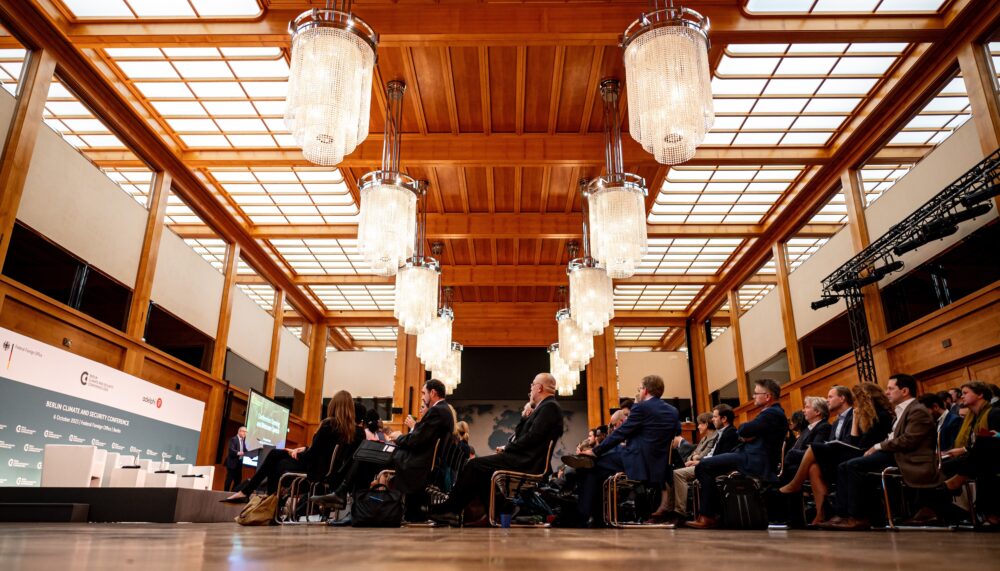
Ahead of the Berlin Climate and Security Conference, we explore what Germany should do to support the climate, peace, and security agenda.
Climate stress and conflict increasingly overlap. Climate stress does not automatically cause conflict. But where it interacts with weak governance, inequality, and existing instability, it can increase pressure on resources and deepen grievances.
Germany is actively advocating for more support for the climate-security nexus. Yet multiple questions remain around how it can best leverage its position to further advance this cause.
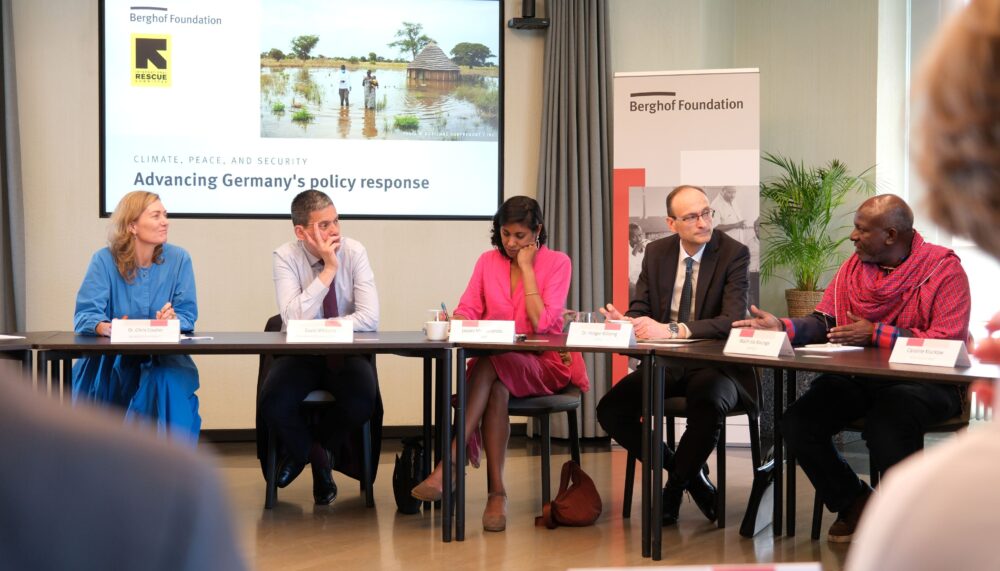
This was the subject of a roundtable on “Climate, peace, and security: Advancing Germany’s policy response”, co-organised with the International Rescue Committee Germany, at our office in Berlin in July. Leading stakeholders from politics, business, academia, and civil society discussed how Germany can more effectively embed climate-related security risks into its national security architecture as well as facilitate access to climate finance for conflict-affected countries.
Berghof’s Executive Director Chris Coulter said Germany “needed to align what already exists far more effectively.” She stressed that climate change is not simply a technical issue: it shapes dialogue and mediation and can also provide an entry point for negotiations.
Climate change is not simply a technical issue: it shapes dialogue and mediation and can also provide an entry point for negotiations.
Chris Coulter, Executive Director
Connecting climate, peace, and security
For years, climate change and security have been treated as separate issues. Security discussions still follow a conventional military approach. The effects of climate change are not only felt in fragile and conflict-affected countries though but also on supply chains, energy prices, and food security, which have political consequences for Germany and Europe. This framing does not dilute Germany's responsibility or solidarity with the countries hit hardest. However, it makes preventive action politically legible to a wider audience.
The time has come for political leaders to treat climate risk as a core national security priority. A positive sign in this direction was registered at this year’s London Climate Week where climate and nature were framed as systemic risks.
Where the gaps remain
If climate is genuinely treated as a security threat, funding should follow. However, global aid budgets are shrinking. Even if programmes stop running, affected communities still must keep living with the consequences and adapt accordingly. This is compounded by the fact that countries most affected by climate change receive the least funding.
The broader collective-action problem around climate finance also raises a hard question of fairness: who gets left behind? And how do they get brought back into the conversation?
Germany’s policy response
Germany is already playing a leading role in connecting climate, peace, and security. Together with the island state of Nauru, Germany established the UN Group of Friends on Climate and Security with now over 70 Member States. It placed climate security within its Foreign and National Security Strategy and has an advisory commission drawing on civil society expertise, among others. Ahead of this year’s Berlin Climate and Security Conference, the priority should now be to connect existing policies, institutions, and expertise and turn them into practical action.
First, Germany should strengthen coordination across foreign policy, development, humanitarian action, climate, and security. Ministries and agencies need shared analysis and clearer objectives, particularly in fragile and conflict-affected countries.
Second, Germany should make climate action more conflict sensitive, while ensuring that peacebuilding and humanitarian programmes account for climate pressures. It should also connect high-level diplomacy and mediation more effectively with local authorities and communities.
Third, Germany should keep conflict prevention and climate adaptation at the centre of its response. As aid budgets shrink, funding decisions should protect anticipatory action and support communities already facing the combined effects of climate shocks, conflict, and weak governance.
Germany cannot advance this agenda alone. It should continue to work with the United Kingdom, France, and other European partners on shared analysis and coordinated diplomacy. The United Kingdom's new taskforce on nature, climate, and security offers one possible route for exchange. Closer European cooperation would also give Germany’s agenda greater weight in international forums at a time of geopolitical fragmentation and tighter budgets.
Finally, climate security must move beyond its usual policy circles. The case for it needs to be presented in the rooms where decisions on defence, trade, energy and critical minerals are made. Germany has helped build the climate, peace, and security agenda. Its next challenge is to turn that leadership into a joined-up policy that prevents conflict, supports communities, and treats climate resilience as part of security preparedness.
Media contact
You can reach the press team at:
+49 (0) 177 7052758
email hidden; JavaScript is required