BLOG POST | 27 Mar 2026
Climate adaptation and peacebuilding keep missing each other
Why does that matter?
Climate and conflict are interconnected, but responses remain fragmented. Aligning peace and climate adaptation is key to effective resilience in fragile contexts.
By Sebastian Kratzer, Nazanine Moshiri
In fragile and conflict-affected contexts, climate change and conflict reinforce one another by interacting with existing political, social, and economic vulnerabilities. Climate impacts affect livelihoods, access to resources, and governance systems, while conflict and weak institutions undermine the effectiveness of climate adaptation. Despite this, peacebuilding and climate adaptation efforts still largely operate separately. Climate actors tend to focus on infrastructure, livelihoods, and risk management, while peace actors prioritise dialogue, mediation, and stabilisation. Put simply, both communities are trying to address similar underlying risks, but from different angles and without enough coordination between them.
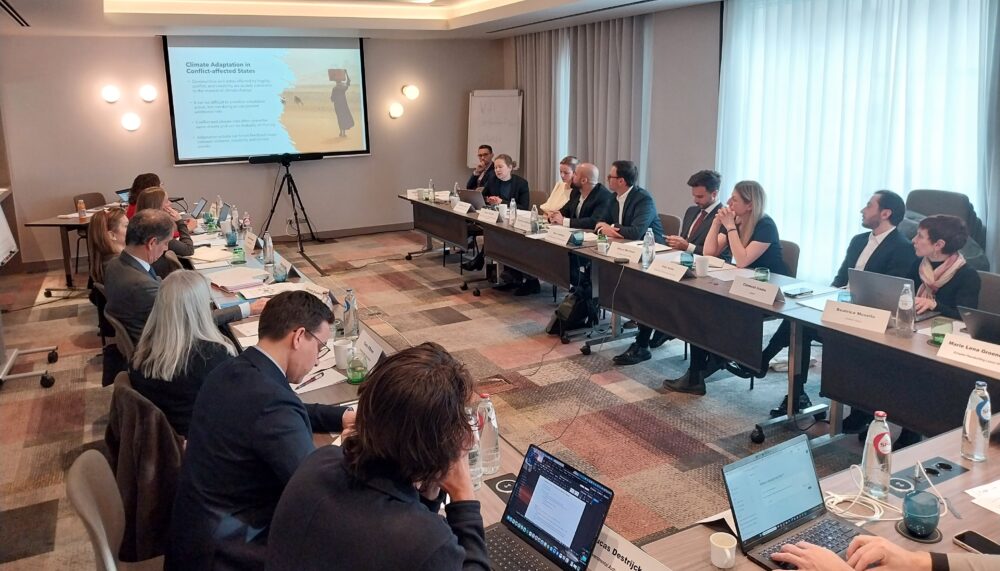
At the launch workshop of a new EU initiative on policy coherence for adaptation resilience, practitioners from the Berghof Foundation, the Centre for Humanitarian Dialogue, and the International Institute for Sustainable Development (IISD) came together with policymakers to address the persistent gap between peacebuilding and climate adaptation policy in conflict-affected settings.
What stood out in the discussion was not a lack of awareness, but how persistently both communities continue to operate in parallel despite recognising the problem, probably due to institutional and political constraints.
One key takeaway was that climate pressures rarely create new conflicts but often sharpen existing ones. Aligning peacebuilding and climate adaptation efforts can strengthen resilience, legitimacy, and long-term stability more effectively and at lower cost than treating them in isolation. This matters all the more in a context where spending priorities are shifting towards defence, making it increasingly important that resources are used as effectively as possible.
Why alignment matters
Climate change acts as a risk multiplier. It exacerbates inequality and marginalisation, and strains already weak governance systems in fragile settings. At the same time, weak institutions, low levels of trust within societies, and political exclusion reduce the effectiveness and sustainability of adaptation measures. This creates a vicious cycle where climate pressures deepen instability, while instability limits societies’ ability to adapt.
Ignoring the links between peace and climate adaptation in such contexts is therefore short-sighted. Experience from practice shows that climate adaptation can generate peace dividends when it strengthens institutions, eases distributional tensions, and builds trust between communities and authorities.
So why does this gap persist?
Both communities have made considerable progress in recent years. Peacemaking and peacebuilding organisations increasingly integrate environmental factors into conflict analysis, while climate and environmental actors have begun to apply conflict-sensitivity and “Do No Harm” principles.
Yet these efforts often remain focused on avoiding negative impacts rather than pursuing shared objectives, aligned strategies, or joint definitions of success.
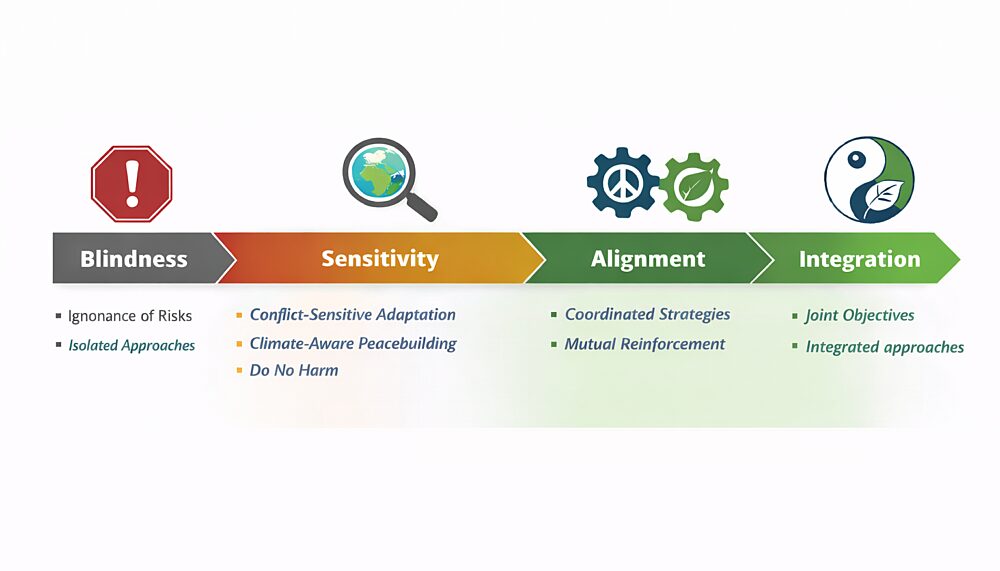
In practice, the two fields continue to operate under separate mandates, funding streams, and institutional logics. National climate policy processes, such as National Adaptation Plans (NAPs) and Nationally Determined Contributions (NDCs), are relatively more structured than peacebuilding frameworks which can reinforce the disconnect in practice. In fragile settings, this imbalance can lead to adaptation initiatives that overlook conflict dynamics, or peace processes that fail to account for climate-related pressures shaping grievances and instability.
This disconnect plays out in very concrete ways. In Southern Iraq for example, climate-induced water scarcity has intensified disputes between agricultural communities, service providers, and authorities. These tensions are driven not only by physical scarcity but also by governance failures and mistrust. While peacebuilding efforts address grievances related to access or governance failures, they often fail to engage with adaptation planning that could help manage worsening scarcity over time. Conversely, adaptation responses focused on infrastructure or efficiency often overlook local conflict dynamics, contributing to resistance or perceptions of unequal benefit-sharing.
What alignment means in practice
Aligning peace and climate adaption measures does not require merging mandates or creating new institutions. Rather, it means ensuring that both fields do not work at cross-purposes and, where possible, reinforce one another. In practice, this requires understanding how climate and conflict risks interact, aligning priorities, and coordinating interventions so they reduce shared vulnerabilities.
This also requires strengthening the political and institutional foundations on which both agendas depend, including accountable governance, inclusive decision-making, and basic state capacity. Existing climate policy processes can offer entry points, particularly in post-conflict settings. Work by IISD and the NAP Global Network has demonstrated how such processes can integrate conflict sensitivity and support peacebuilding objectives.
Peace agreements may also include provisions on land, water, or resource governance that need to adapt to changing climate realities. Peace processes that, for instance, address water management can offer opportunities to integrate adaptation considerations into post-conflict governance arrangements.
Financing is another critical challenge. Discussions during the workshop underscored that increasing the scale of funding alone is not enough. Investments in climate and peace must also address underlying drivers of vulnerability and conflict. This includes prioritising gender equality, land rights, and fair distribution of benefits.
From concepts to political practice
Achieving greater alignment requires political will, sustained cross-sectoral cooperation, a willingness to acknowledge and manage risks, and clearer, compatible objectives. This matters because fragile settings experience significant gaps between national policies, subnational authorities, and local realities, which is often where climate stress and conflict pressures converge. Sustained engagement with civil society, parliaments, and security actors is therefore essential to making alignment work.
When pursued effectively, it offers a pragmatic and politically grounded path towards more durable resilience in fragile contexts.
Without stronger alignment, efforts risk remaining well-intentioned but ultimately insufficient in the face of growing climate and conflict pressures.
Media contact
You can reach the press team at:
+49 (0) 177 7052758
email hidden; JavaScript is required