MHPSS
Mental health and psychosocial support (MHPSS) refers to any form of support, whether provided locally or by external actors, that seeks to protect or promote psychosocial wellbeing and to prevent or address mental health conditions. The term psychosocial refers to the dynamic relationship and constant interplay between psychological processes and social conditions.

See also: Peacebuilding, dealing with the past, mediation
Armed conflict generates profound psychosocial impacts at individual, family, and community levels. Beyond immediate violence, conditions such as mass displacement, economic loss, destruction of infrastructure, and widespread human rights violations cause intense emotional distress and can develop into serious mental health conditions, including post-traumatic stress disorder, depression, anxiety, and substance use disorders. At the family level, conflict may destabilise relationships, shift roles and responsibilities, and increase domestic violence. At the community level, it deepens polarisation, discrimination and stigmatisation, eroding trust, breaking down social support systems, and disrupting cultural practices that communities rely on for cohesion.
These responses are best understood not as manifestations of pathology, but as normal reactions to extreme adversity. Yet, if left unaddressed, their consequences can constrain individual and collective agency and coping capacities and weaken societal resilience. In turn, they may themselves become drivers of further violence, perpetuating vicious cycles that are often transmitted across generations and become embedded in the social fabric.
MHPSS and peacebuilding mutually influence one another. The stronger people’s mental health and psychosocial well-being, the greater their capacity to engage constructively with conflict – whether at the individual or at the community level.
Rachel Gasser, Senior Advisor Negotiation and Mediation Support
Psychosocial perspectives are essential not only for supporting recovery for those affected by violent conflict, but for understanding the dynamics that drive conflict in the first place. Violence is often fuelled by polarisation rooted in fear or grievances, dehumanisation, the instrumentalisation of social narratives or sacred values, and an erosion of trust. We therefore need to engage with emotional, relational, and social drivers, alongside political ones, in order to transform violent conflicts into lasting peace.
This is why we strive to systematically embed psychosocial principles across core areas of our work, including dialogue facilitation and mediation support, transitional justice and reconciliation, peace education, and social cohesion programming.
MHPSS plays a core role in our efforts to strengthen the foundations for long-term stability and peace in Iraq, Somalia, and Yemen. We embed psychosocial perspectives into conflict and gender analysis, create psychologically safe spaces for inclusive dialogue, and strengthen the capacities of facilitators and local peacebuilders to address psychosocial dimensions of conflict. We also foster cross-sector learning and collaboration between the peacebuilding and MHPSS sectors, whilst advocating for the integration of MHPSS into peace and reconciliation policies.
Recognising that stress and trauma can impair communication and emotional readiness for engagement, we apply trauma-informed and survivor-centred principles to the degin and facilitation of dialogue processes, for example, when working with women from resistance and liberation movements or with insider mediators in Zimbabwe. In practice, this means complementing dialogue sessions with stress-relief and trauma-healing activities, offering optional individual psychological counselling alongside group-based processes, and creating safer spaces for sharing experiences of suffering and coping.
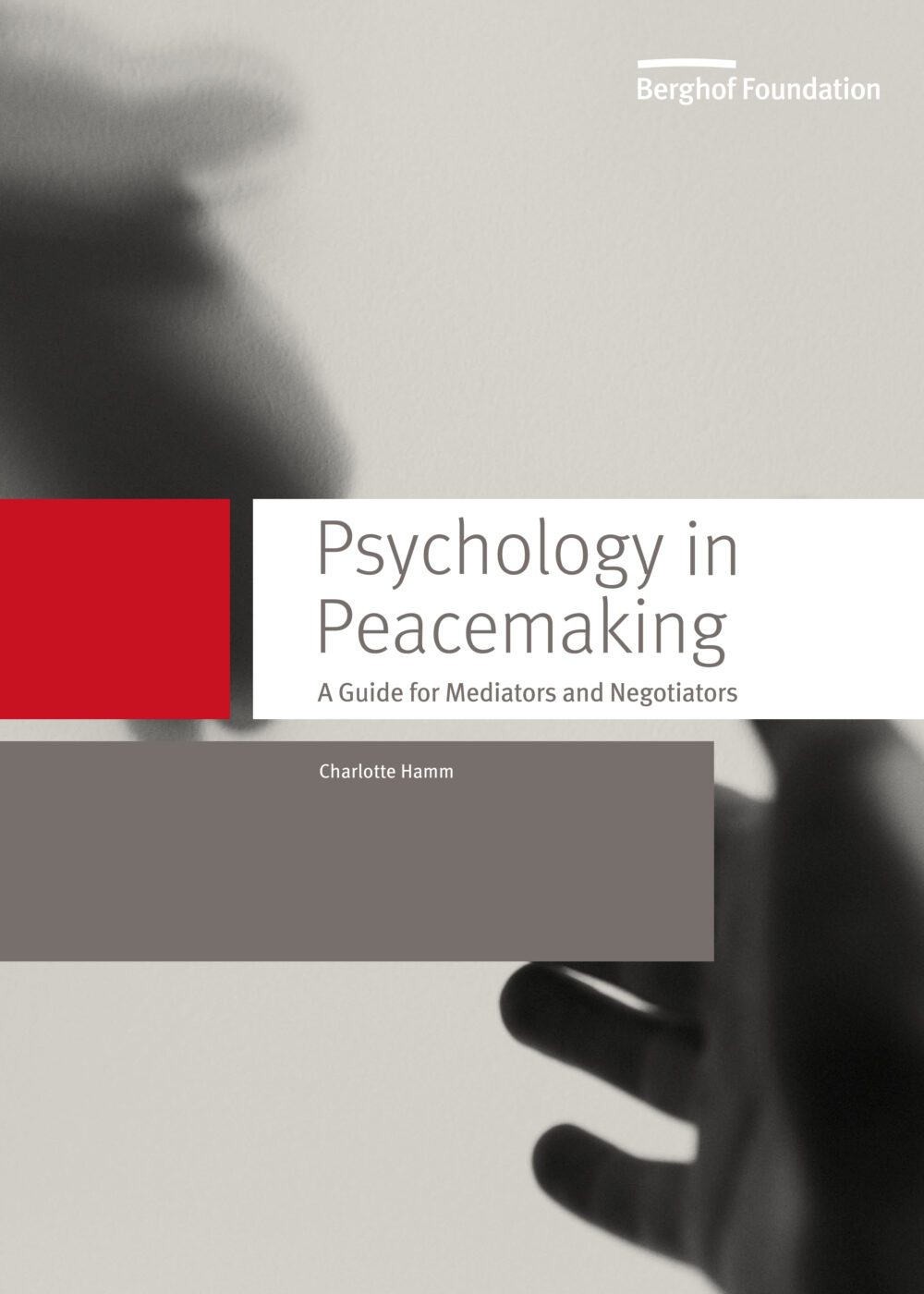
Berghof’s Psychology in Peacemaking guide further illustrates how psychological factors, such as dehumanisation of adversaries or unresolved trauma, shape negotiation processes, and offers practical tools for mediators to navigate these dynamics in peace negotiations.
We believe that collective healing is essential to addressing the impacts of mass violence and to building lasting peace. Rebuilding societies after atrocities requires restoring the social fabric and addressing individual and collective mental health and psychosocial needs. In our dealing-with-the-past work in the Georgian-Abkhaz conflict, we combined biographical interviews with participatory dialogue workshops across conflict lines. By creating safer spaces for reflection on memory, history, and identity, and facilitating exchange that acknowledged grievances on all sides, reconciliation and trauma healing became integral to our work in the region.
At the same time, it is important to support the people who do this work. Providing wellbeing sessions, stress management support, and needs-based psychological counselling for staff, partners, and facilitators operating in high-stress environments is an integral part of our work in contexts such as Iraq, Lebanon, Myanmar and Somalia.
Sustainable peace cannot be built without attending to the psychological and relational dimensions of conflict. As violence and its legacies continue to shape communities around the world, integrating psychosocial perspectives into peacebuilding and peacemaking is not an add-on, it is a necessity
Learn more
- Psychology in Peacemaking: A Guide for Mediators and Negotiators
- Organisations under pressure but powering on: The psychosocial approach within integrated management of threat
- The Power of We: How collective processes allow healing after mass atrocity – Reflections from the field
- Transformative Transitional Justice in Practice: Confronting Challenges, Recognising Successes Practitioners’ Conference, 21-22 October 2025 – Conference Report
- Dealing or healing? Trauma-responsive approaches in times of transactional peacemaking
- Women peacebuilders at the centre: How psychosocial awareness makes peacebuilding safer, more sustainable, and more effective
- Psychology and peacemaking: The inner dynamics of peace negotiations
- The brain and peace: How can insights from neuroscience advance peacebuilding?