FEATURE | 8 Sept 2026
Negotiating against all odds
Our Senior Mediation Advisor Luxshi Vimalarajah speaks with WOZ about negotiating peace amid record conflict numbers and shrinking funding for conflict resolution.
This is a translation of an article originally published in the Swiss newspaper Wochenzeitung (WOZ) on 20 August 2026. Read the article on their website (in German).
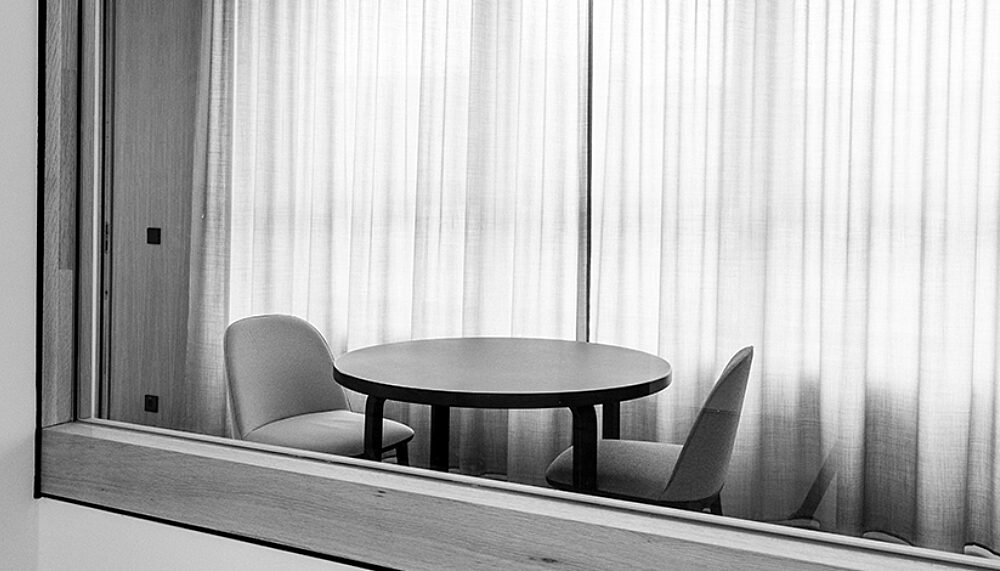
Peace negotiations, says Luxshi Vimalarajah, are protracted and complicated. Take the seating arrangement, for example: who sits on which side, who shakes whose hand first? Which of the conflict party has what needs or fears? Are there any past relationships between the negotiators? Above all, however, what is needed is their willingness to talk to one another. And a great deal of realism.
Vimalarajah is sitting at a small conference table in a modern office complex in Berlin-Kreuzberg. For 23 years, she has been mediating in international conflicts and crises around the world. She has worked in Sri Lanka, Myanmar, Colombia, Nepal and Yemen, amongst other places. It was not uncommon for her to see negotiations fail, or for her to be able to measure their success only years later.
There is currently a great deal of mediation work to be done around the world: the number of conflicts is higher than at any time since the end of the Second World War. Last year, Uppsala University’s ‘Conflict Data Programme’ counted 65 armed conflicts in 35 countries. And the number of victims of armed conflicts worldwide is higher than it has been since 1994, the year of the genocide in Rwanda. Often, more than two parties are fighting each other; civil wars such as those in Sudan or Myanmar are characterised by fragmentation, shifting alliances and the influence of other states. All of this makes mediation work even more complex than it would otherwise be.
Growing importance
Vimalarajah’s employer is the Berghof Foundation in Berlin. The NGO is one of 27 members of the Mediation Support Network, a global organisation of NGOs committed to promoting mediation in peace negotiations; its members also include, for example, the Swiss organisations Swisspeace and the Centre for Humanitarian Dialogue in Geneva. Private mediators usually act as impartial third parties, thereby complementing the efforts of states and international organisations.
We are no guarantee of peace, but we can create the framework for dialogue, particularly in complex situations.
Luxshi Vimalarajah, Senior Mediation Advisor
“We are no guarantee of peace, but we can create the framework for dialogue, particularly in complex situations,” says mediator Vimalarajah. She knows complex situations from personal experience: Vimalarajah grew up as a member of the Tamil minority in Sri Lanka and was still a child when the civil war broke out there in 1983. Hundreds of thousands, including Vimalarajah and her family, were forced to flee as the army and the Liberation Tigers of Tamil Eelam (LTTE) fought each other. This experience, she says today, was one of the reasons why she later went on to study political science in Germany.
In 2003, she returned to Sri Lanka as a mediator for the Berghof Foundation. The conflict had eased somewhat following a ceasefire the previous year. Neither the army nor the LTTE had been able to win the conflict militarily; “there was a military stalemate”, she says. At first, the two sides barely spoke to one another. The LTTE accused the government of ordering ethnic cleansing. The government accused the LTTE of carrying out terrorist attacks and of having no interest in a political solution.
A classic situation in which mediators such as the Berghof Foundation play a decisive role. Their importance has grown steadily since the end of the Cold War, when peace diplomacy was initially shaped primarily by the UN and state actors, says Achim Wennmann, a professor at the Geneva Graduate Institute. He has been researching international peace mediation for decades. “Unlike governments or the UN, private mediators can also engage with non-state actors who are, for example, listed as terrorist groups or subject to sanctions,” explains Wennmann. Often acting on behalf of state or international institutions, they are able to establish robust networks and build trust on all sides long before official negotiations begin.
At the time, mediators from the Berghof Foundation remained in Sri Lanka for almost seven years to facilitate six rounds of negotiations across several countries under a mandate from the Norwegian government. Intellectuals, former politicians and other influential figures from both sides took part in local dialogue forums, explains Luxshi Vimalarajah. There, potential solutions were discussed jointly and role-plays facilitated a change of perspective. “At their best, peace processes always take place at local and civil society levels as well as at the leadership level,” says Vimalarajah. It often takes years before anything happens, and only rarely does a classic negotiation situation arise in which the parties to the conflict sit face to face.
Difficult funding situation
According to the ‘PA-X Peace Agreements Database’, a database maintained by the University of Edinburgh, around sixty peace agreements were concluded worldwide last year at state, non-state and regional levels – most of them limited in scope or duration. Sustainable, comprehensive peace agreements, however, remain the exception. Vimalarajah’s personal track record is also sobering: in 23 years, she has mediated in eight conflicts. Only in a few cases has there been lasting success, including in North Macedonia and the Basque Country.
In Sri Lanka, however, the efforts failed. In 2007, the Sri Lankan government declared the chair of the Berghof Foundation persona non grata and, shortly afterwards, launched a major offensive against the LTTE, which was to cost tens of thousands of lives by 2009. “We simply hadn’t analysed the history of the conflict well enough,” says Vimalarajah today. Nevertheless, she adds, the years of mediation efforts were not in vain. On the contrary: many local civil society actors and those previously marginalised were empowered, and the learning process for future negotiations was significant. “Peace processes often cannot be measured solely by the conclusion of an agreement,” says Vimalarajah.
However, whilst global spending on arms is currently reaching new highs, expenditure on conflict diplomacy is stagnating. According to the Organisation for Economic Co-operation and Development (OECD), global funding for peacekeeping and conflict prevention last year was at its second-lowest level since 2004. Achim Wennmann says this is increasingly leading to competition between private mediation organisations.
Organisations such as the Berghof Foundation (with an annual budget of around twenty million Swiss francs) and the Centre for Humanitarian Dialogue (around fifty million Swiss francs) are among the largest private conflict mediators in Europe. They are funded primarily by international institutions such as the EU, as well as by government donors such as Germany’s Federal Foreign Office or the Swiss Federal Department of Foreign Affairs. However, according to Wennmann’s calculations, the combined budget of the ten largest NGOs in this field amounted to just around 250 million Swiss francs in 2023 – roughly 0.01 per cent of global military spending. “That’s enough to fund about ten metres of an American nuclear submarine,” says Wennmann.
Added to this is the current, profound shift in the international landscape. The war against Ukraine has led to a shift in foreign policy priorities in Europe towards security and defence. And the major powers are once again competing more aggressively for dominance, whilst traditional institutions such as the UN and the Organisation for Security and Co-operation in Europe (OSCE) are struggling with a growing inability to act. Meanwhile, regional actors in some places have seized the moment to gain influence. The “multipolar world” is taking shape.
A trend towards short-term thinking
On the one hand, this does open up the possibility of a fairer international order in which different regions and perspectives are better represented, says Luxshi Vimalarajah. At the same time, however, the long-term examination of the root causes of conflict is taking a back seat, whilst top-down, short-term solutions are gaining prominence. “There is increasing discussion of military coercive measures and military pressure,” says Vimalarajah, “whilst dialogue and human rights are increasingly taking a back seat.” States such as Pakistan, which recently mediated between the US and Iran, have long been using negotiations to bolster their own reputation and economic interests, as well as to divert attention from domestic political problems.
Even if the progress made is often small and fragile, it nevertheless enables cautious rapprochements time and again.
Given the global wave of autocracy and the decline in the standing of democratic institutions, this is hardly surprising, says Achim Wennmann. Nevertheless, the traditional Western model of peacebuilding, which has shaped conflict diplomacy for decades, should not be overrated, says the peace researcher: even its principle of justice has often been more of an academic discourse than an actual strategy pursued in practice. Moreover, even classic mediating states such as Norway have always reconciled their peace efforts with foreign policy interests and, in some cases, close ties with the US.
Wennmann, on the other hand, sees great potential for future peace processes at the local level. In many places, countless people – particularly from the younger generations – are still committed to democratically legitimate forms of government and administration. “Local movements are often overlooked, yet they can help where peace negotiations at a higher level fail,” he says.
Luxshi Vimalarajah also notes that, because traditional peace mediation is stalled in many places, informal dialogue and mediation processes are becoming increasingly important. “We are receiving more requests of this kind today than ever before,” she says. Whilst this may be less visible to the public, she adds, it can nevertheless help to explore new ideas and keep channels of communication open. And even if the progress made is often small and fragile, it nevertheless enables cautious rapprochements time and again. “Peace rarely comes about in great leaps,” says Vimalarajah. Instead, many small steps are needed – and many courageous people.
Media contact
You can reach the press team at:
+49 (0) 177 7052758
email hidden; JavaScript is required