CURRENT PROJECT
Radicalisation research and prevention in Germany
Expert panels as an integral component of a monitoring system and a transfer platform

The MOTRA research network counters violent radicalisation through phenomenon monitoring, knowledge transfer and networking with different actors and perspectives.
Timeframe: 2019 - 2028
The Germany-wide research network MOTRA (Monitoring System and Transfer Platform Radicalisation) creates a central monitoring platform for the early detection and prevention of extremism and serves as a focal point for academia, authorities, civil society and policymakers. The researchers conduct systematic and holistic monitoring on violence-oriented radicalisation in Germany.
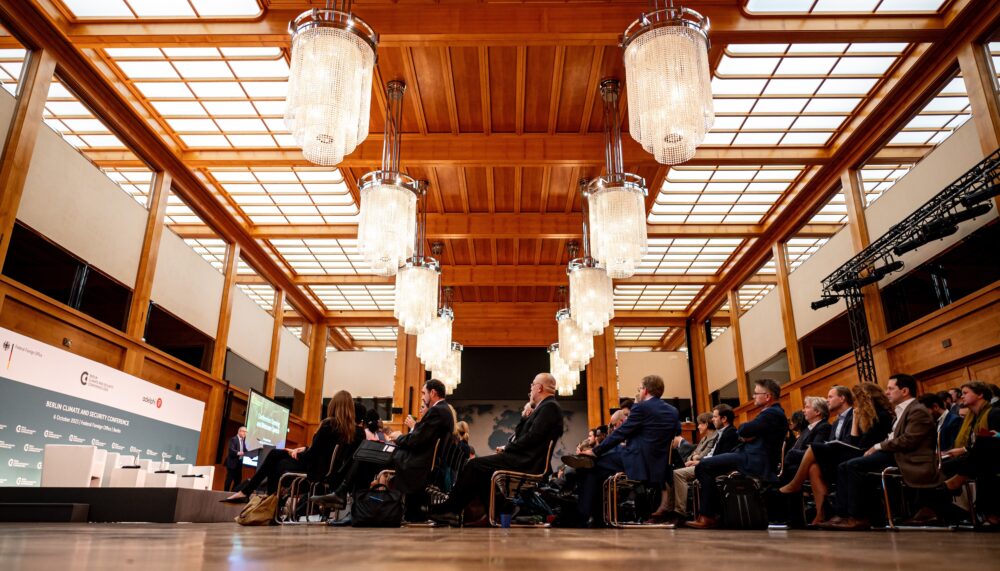
The Berghof Foundation contributes to the MOTRA monitoring system with qualitative expert interviews and focus group discussions at national and regional level, in which representatives from science, government agencies and civil society participate. These panels aim to identify covert and new radicalisation processes on the one hand and on the other hand intend to capture different social perspectives on these phenomena and the associated challenges. In the longer term, the panels will contribute to strengthening the practical relevance of the questions pursued in the network, such as the conflict sensitivity of survey perspectives and instruments.
Project website: www.motra.info
Background
Radicalisation and extremism, including terrorism, pose an ongoing challenge to democratic societies. We understand violent radicalisation as a consequence of inadequately managed societal conflicts. Consequently, MOTRA also views the prevention and combating of radicalised violence as a task for society as a whole and aims to contribute to this effort.
Particular emphasis is placed on identifying and preventing extremism before it can turn into violence . To this end, it is essential to generate knowledge about the extent, development, forms, and causes of political and/or religiously motivated extremism and to transfer this knowledge to the relevant fields of action in science, politics, and practice.
The collaborative project MOTRA contributes to evidence-based policy and practice by pursuing two central objectives:
- Empirical-analytical objective: monitoring radicalisation in Germany
Holistic and systematic monitoring is implemented using multi-methods, longitudinal phenomenon and trend analyses and in-depth case studies. Systematic phenomenon monitoring enables faster identification and classification of new phenomena. Therefore, it provides a basis of information for drawing conclusions on significant developments regarding the observed phenomena. - Structural objective: an active transfer platform for science, practice, and politics
The platform shares MOTRA's findings with researchers, practitioners and policymakers. It also connects existing research initiatives in Germany that address these phenomenna. In this way, it aims to shorten the time between research findings being produced and being put into practice.
The Berghof Foundation in the MOTRA consortium
The Berghof Foundation builds on its experience in creating spaces for dialogue and conflict transformation and brings the field of peace and conflict research to the interdisciplinary consortium. It contributes to MOTRA's overarching goals by organising regular qualitative expert panels at the regional and national levels.
These expert panels have three objectives: (1) to involve a broad spectrum of actors in the identification of hidden or new radicalisation processes, (2) to include different societal perspectives into the evaluation of these phenomena and the challenges associated with them, and (3) to strengthen the practical relevance of the issues pursued by the consortium and the conflict sensitivity of survey perspectives and instruments.
The panels include experts from academia, security agencies, and civil society, with a particular focus on practitioners in social education and social work who work on prevention. By incorporating practical perspectives, the Berghof module combines the empirical-analytical and structural objectives of MOTRA.
In line with the objective of discovering new and hidden trends, the surveys are characterised by an open and flexible approach to questioning. This allows respondents to focus on the issues that are important to them. In addition, this module focuses on different perspectives on radicalisation, reciprocal and co-radicalising dynamics, gender-specific aspects, and the interplay between online and offline processes.
In cyclical data collection, the same experts participate several times over the course of the project. This allows findings from the previous cycle to be incorporated into the survey and to observe how processes change over a longer period of time.
Partners and funding
The project consortium consists of the following core partner organisations:
- Bundeskriminalamt (BKA), Wiesbaden (lead)
- Karlsruher Institut für Technologie (KIT)
- Kriminologische Zentralstelle e. V., Wiesbaden
- German Institute for Global and Area Studies, Hamburg
- Berghof Foundation Operations gGmbH, Berlin
- Wissenschaftszentrum Berlin für Sozialforschung (WZB) gGmbH, Berlin
- Universität Hamburg
- Ludwig-Maximilians-Universität München
- Hochschule Fresenius (HSF), Wiesbaden
The project is funded by the civil security research program of the German Federal Ministry of Research, Technology, and Space. The project is also funded by the German Federal Ministry of the Interior and the German Federal Ministry for Education, Family Affairs, Senior Citizens, Women and Youth.
Publications from this project:
- "Wenn man Menschen erst einmal so weit hat, dass sie sich hier nicht zuhause fühlen…". Radikalisierung im Kontext aktueller gesellschaftlicher Dynamiken. Ergebnisse der regionalen Expert*innen-Befragung "Islamistischer Extremismus" 2024/2025
Michaela Glaser. 2026
- Unter dem Radar: Protest und Mobilisierung gegen Geflüchtetenzuzug. Ergebnisse der MOTRA-Expert*innenbefragung 2023/2024
Michaela Glaser. 2025
- "Weil das jetzt wirklich in den Mainstream reingeht“. Aktuelle Radikalisierungsdynamiken aus Sicht der Praxis Ergebnisse der regionalen Expert*innenbefragung 2022/2023
Michaela Glaser. 2023
- Radikalisierung, quo vadis?. Trends und Schlaglichter aus dem nationalen Expert*innenpanel
Michaela Glaser, Beatrix Austin. 2022
- Radikalisierungsprävention durch eine friedensfördernde Brille. Blinde Flecken und neue Perspektiven
Beatrix Austin, Andreas Schädel, Tilman Papesch. 2021
Publications from this project:
Uwe Kemmesies, Peter Wetzels, Beatrix Austin, Christian Büscher, Axel Dessecker, Swen Hutter & Diana Rieger: MOTRA-Monitor 2023/24. MOTRA. 2025.
Uwe Kemmesies, Peter Wetzels, Beatrix Austin, Christian Büscher, Axel Dessecker, Sven Hutter & Diana Rieger: MOTRA-Monitor 2022. MOTRA. 2023.
Uwe Kemmesies, Peter Wetzels, Beatrix Austin, Christian Büscher, Axel Dessecker, Edgar Grande & Diana Rieger: MOTRA-Monitor 2021. MOTRA. 2022.
Uwe Kemmesies, Peter Wetzels, Beatrix Austin, Axel Dessecker, Edgar Grande, Isabel Kusche & Diana Rieger: MOTRA-Monitor 2020. MOTRA. 2021.
Related publications:
Papesch, Tilman, Michaela Glaser: Swipen, liken, täuschen?. Antidemokratische Desinformation auf TikTok, ihre Rezeption durch junge Menschen und demokratische Gegenstrategien. 2026.
Engjellushe Morina, Beatrix Austin, Tim Jan Roetman & Veronique Dudouet: Community Perspectives on Violent Extremism: Strengthening local factors of social resilience. Policy Brief. Berghof Foundation. 2019.
Engjellushe Morina, Beatrix Austin, Tim Jan Roetman & Véronique Dudouet: Community Perspectives on Preventing Violent Extremism Lessons learned from the Western Balkans. Research Report. Berghof Foundation. 2019.
Karin Göldner-Ebenthal & Véronique Dudouet, with support from Marie Migeon: Dialogue with Salafi jihadi armed groups: Challenges and opportunities for conflict de-escalation. Berghof Foundation. Berlin 2019.
Cassandra Schützko & Hazem Elgafari: Preventing Radicalisation and Supporting De-Radicalisation. Approaches and Main Stakeholders in Germany. Berghof Mapping Study (available upon request). 2017.
Project lead
Michaela Glaser
Senior Researcher and Project Manager
email hidden; JavaScript is required
Team members
Media contact
You can reach the press team at:
+49 (0) 177 7052758
email hidden; JavaScript is required