CURRENT PROJECT
Infrastructures for peace and environmental peacebuilding in Galmudug and Hirshabelle State, Somalia
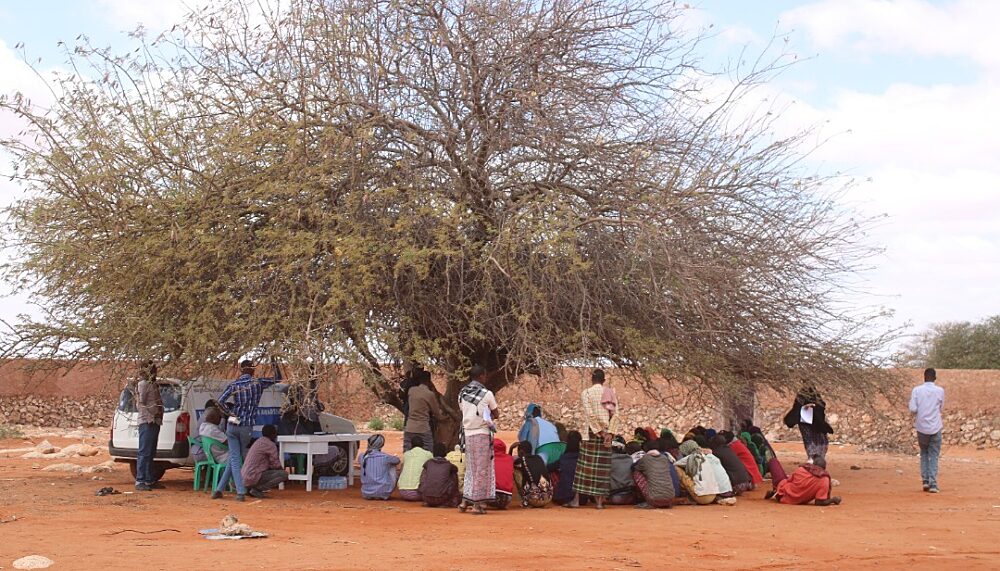
This project focuses on the nexus between climate change and conflict in these two federal member states and is part of the Peace Pillars Consortium.
Timeframe: 2023 - 2026
The project “Infrastructures for Peace and Environmental Peacebuilding in Hirshabelle and Galmudug State, Somalia” builds on the Berghof Foundation’s engagement in previous projects with infrastructures for peace (I4P) in the two federal member states of Galmudug and Hirshabelle and focuses on the nexus between climate change and conflict. The project is part of the Peace Pillars Consortium, managed by adelphi and funded by the German Federal Foreign Office.
The overarching objective of the project is to take an environmental peacebuilding approach to contributing to the constructive transformation of conflict, considering the impacts of climate change and environmental degradation on livelihood resources, coping mechanisms and resource conflict, and the opportunities that arise from shared environmental challenges.
This objective is pursued through several activities:
The project facilitates sustained dialogue (SD) processes in two climate-conflict hotspots in Hirshabelle and Galmudug. The processes provide a safe and inclusive space for community representatives to meet regularly, analyse conflict dynamics and jointly explore pathways towards peace. The processes have rebuilt broken trust, developed shared understanding of environmental challenges and conflict drivers, and strengthened cooperation across divides on collaborative solutions to address the challenges.
The project supports and strengthens existing infrastructures for peace at regional and community levels. Through strategic coordination meetings and capacity-development workshops, civil society organisations, members of the Insider Peacebuilders Network (IPN), and government representatives enhance their knowledge and skills in conflict transformation and environmental peacebuilding. These activities promote cooperation among these key stakeholders and strengthen coordination and sustainable peacebuilding efforts.
The project produces two radio programmes, Garasho-wadaag (Sharing of knowledge) in Galmudug and Hiloow (Longing) in Hirshabelle, which reach thousands of listeners, including communities in remote and hard-to-access areas. Through a drama series, live discussions with community peacebuilders, government representatives and thematic experts, as well as audience call-ins, the programmes address current social, political, economic and environmental issues. They raise awareness of environmental peacebuilding approaches, stimulate community dialogue and promote locally-led solutions. Responding to strong audience demand, the frequency of the programmes was increased from once to twice a month, starting in 2024.
Another central element of the project is the direct support to IPN members’ district-level environmental peacebuilding and conflict transformation initiatives, which are grounded in their local knowledge, relationships and access to their communities. The technical, financial and organisational support enable the IPN members to respond flexibly to emerging conflicts and environmental action, engage directly with stakeholders and mobilise locally owned peacebuilding processes, which contribute to strengthening social cohesion and environmental protection, restoration and care.
The project supports the organisation of highly inclusive, large-scale community dialogue assemblies (Shirarka) in selected districts across Hirshabelle and Galmudug, which have been playing an important role in strengthening a culture of dialogue, reinforcing social cohesion, and enhancing community engagement in peacebuilding processes. The creative and participatory design of the Shirarka facilitates collaborative learning, visioning and problem solving. Lately, this has been further enriched with practical, hands-on learning on regenerating the environment through restoration of degraded land, alternative and climate-resilient farming methods, and community-based disaster preparedness and response. This integration of environmental and peacebuilding perspectives has strengthened the relevance of the Shirarka for addressing both conflict drivers and environmental challenges in a holistic manner.
Background
In the two Somali federal states of Hirshabelle and Galmudug, conflicts revolve around clan lines and access to political power and natural resources. In recent years, the impact of climate change on the environment, natural resources and livelihoods have intensified. Extreme weather events have increased dramatically. Droughts, floods and sandstorms are impeding the livelihoods of millions of Somalis, especially in rural areas that are home to traditional pastoralists and farmers. Conflict around natural resources such as water, pastures or farming land, are being exacerbated and are turning violent more frequently. Without addressing climate change and the impact it is having on the Somali communities, sustainable peace is difficult to achieve.
But both federal states are also home to many engaged civil society and community actors who work tirelessly to foster social cohesion and sustain peace through awareness raising, dialogue and mediation. For many years, the Berghof Foundation has been working closely with these actors of change by supporting a highly inclusive Insider Peacebuilders Network (IPN) spanning the two states, as a key component of an infrastructure for peace.
Partners and Funding
The Berghof Foundation works closely together with state and district administrations in Galmudug and Hirshabelle and the Federal Ministry of Interior, Federal Affairs & Reconciliation. The project is part of the Peace Pillars Consortium that is led by the Berlin-based climate think tank adelphi.
The project is generously funded by the German Federal Foreign Office.
Watch this video with our Peace Pillars Consortium partner adelphi on climate challenges in Somalia:
Updates from this work:
Project lead
Bakhtiyar Aslanov
Project Manager
email hidden; JavaScript is required
Team members
Teresa Isabel Andion-Wessel
Mir Mubashir
Victoria Cochrane
Media contact
You can reach the press team at:
+49 (0) 177 7052758
email hidden; JavaScript is required